
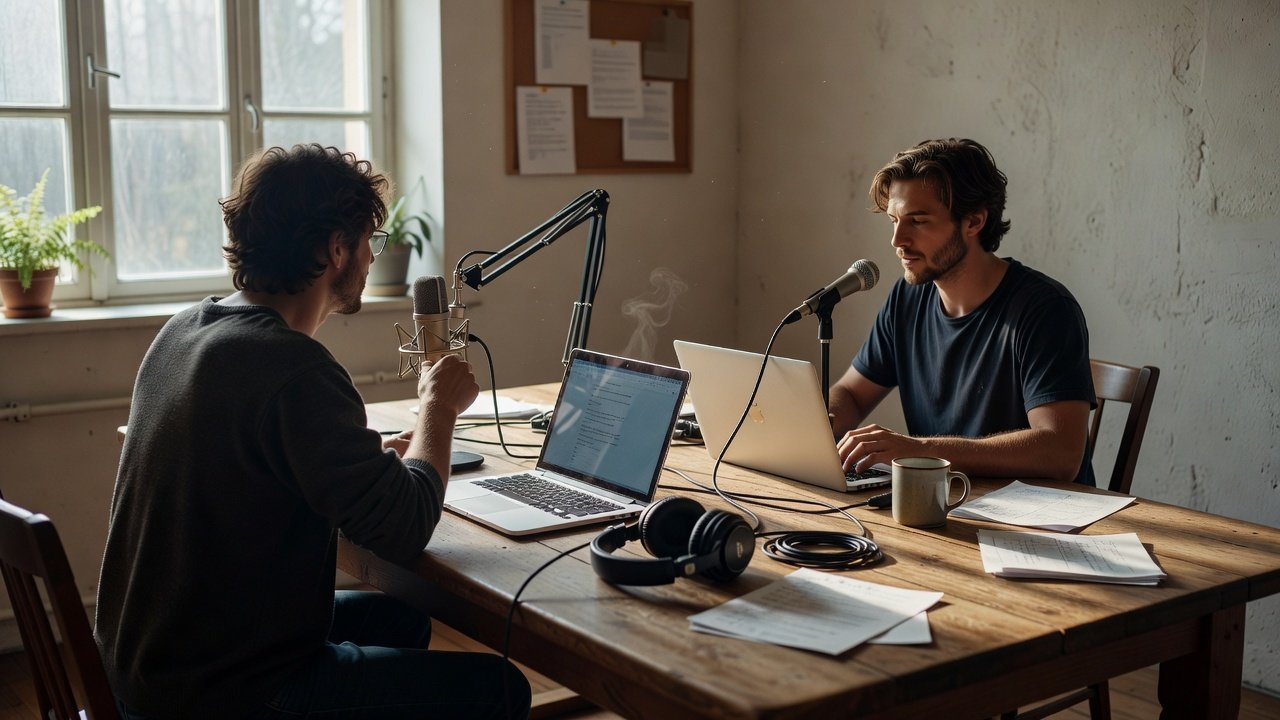
Radiolab kicked off in 2002 as a local WNYC experiment that quickly proved how careful sound layering could turn dense science into something that actually stuck with listeners. Jad Abumrad brought his composer background and philosophy training into the studio, treating each episode like a mix session where interviews, ambient beds, and scripted narration had to lock together in the DAW without feeling forced. Early pilots on topics like time perception and quantum mechanics let the team test those techniques on a shoestring, iterating takes until the pacing felt right before any national audience showed up.
Abumrad’s unconventional path to podcasting shaped Radiolab’s entire DNA. Before launching the show, he spent years composing music and studying philosophy at Bard College, a combination that proved invaluable when approaching scientific storytelling. Rather than adopting the dry documentary format common in educational radio, Abumrad viewed each episode as a sonic architecture problem. He’d layer a host’s curious question, a scientist’s explanation, ambient sound from the field, and a musical underscore in ways that made complex ideas feel emotionally resonant rather than intimidating. This approach meant the first few seasons required extensive post-production work—sometimes spending weeks on a single hour-long episode to get the emotional beats exactly right.
After producing hundreds of episodes myself, the technical reality is that Abumrad’s early experiments at the station gave the show room to fail quietly and refine mic technique and editing workflows without commercial deadlines breathing down their necks. Robert Krulwich came aboard around 2004, adding journalistic weight and that playful back-and-forth that kept the energy alive even when they were recording in makeshift setups. Their on-air chemistry forced tighter editing passes to keep the science accessible while preserving wonder, something that later became a benchmark for education podcasts trying to avoid dry lecture territory.
Krulwich’s arrival marked a turning point in the show’s development. As a seasoned NPR correspondent and science journalist, Krulwich brought credibility and a gift for asking the right follow-up questions—the kind that makes listeners lean in. His journalistic instincts balanced Abumrad’s more experimental, intuitive approach to storytelling. Their collaboration meant that scientific accuracy never got sacrificed for sonic appeal, but neither did accuracy ever overshadow the genuine sense of discovery that made the show compelling. Episodes from this era, like “Emergence” and “Space,” showcased how well their different strengths complemented each other, with Krulwich grounding the narrative while Abumrad’s sound design transported listeners into the conceptual space where the science lived.
In the studio, decisions around episode length and thematic focus make or break listener experience, and the Radiolab team learned this the hard way as they moved toward NPR syndication by 2007. Limited budgets meant resourceful approaches to audio engineering—stacking field recordings, refining EQ curves for emotional hits, and carving space for guest experts without cluttering the frequency spectrum. Those choices helped the show rack up hundreds of millions of downloads while still earning multiple Peabody Awards for audio storytelling.
The move to national syndication through NPR was a critical inflection point. WNYC’s support gave them production resources and distribution reach, but it also meant more rigorous editorial standards and wider audience expectations. The team had to maintain their signature sound design while adapting to an audience far larger than New York’s public radio listeners. This required rethinking recording techniques for clarity across different playback systems—car speakers, earbuds, home speakers—and structuring narratives that worked whether someone caught the episode start-to-finish or pieced it together during a commute. The challenge pushed the production team to document their processes more systematically, creating templates for how to interview sources, record ambient sound, and edit sequences that others could follow.
Behind the scenes, the technical infrastructure that supported Radiolab’s growth was substantial. The show’s production team invested in quality microphones early—not the cheapest options, but gear that offered flexibility in post-production. They built relationships with sound engineers who understood the show’s aesthetic and could execute complex mixes. The WNYC Studios facilities provided access to mixing suites, archival libraries, and equipment that freelance producers couldn’t afford individually. This infrastructure advantage gave Radiolab a head start when podcasting exploded after 2009, and it meant the team could experiment with new formats and longer narrative arcs without worrying that technical limitations would derail a story.
Sound design choices in those episodes raised the bar for what true crime podcasts and comedy podcasts could achieve technically, pushing everyone toward cleaner mixes and more intentional use of silence and texture. Listener memberships kept the production values high once the audience scaled, proving that curiosity-driven narratives, when paired with solid recording setups and thoughtful post-production, could hold their own against flashier formats.
The cultural impact of Radiolab extended beyond audio quality. The show proved that science storytelling could be genuinely entertaining without dumbing down complex ideas. Listeners didn’t need a PhD to follow arguments about consciousness, evolution, or the nature of numbers—they just needed hosts who were asking the questions they’d ask themselves, paired with production that made abstract concepts feel tangible. This opened doors for dozens of science-focused podcasts that launched in the following years, from Stuff You Should Know to StarTalk. Many of these shows borrowed explicitly from Radiolab’s playbook: conversational hosts, careful sound design, and a focus on genuine curiosity rather than exposition.
By the early 2010s, Radiolab had become a reference point for what ambitious audio storytelling could achieve. The show won a Peabody Award in 2006, a second in 2010, and continued earning recognition for stories like “Morality,” “The Invisible Realm,” and “Colors.” These weren’t just popular episodes—they were studied by journalism schools and audio production programs as masterclasses in narrative structure and sonic composition. Universities began assigning Radiolab episodes in science classes, environmental studies programs, and even philosophy seminars, cementing the show’s role in how millions of people actually learn about the world.
The show’s evolution also reflected broader changes in how people consumed audio content. When Radiolab started, podcasting itself was barely a concept. iTunes didn’t have a dedicated podcast section until 2005. By the time the show moved to full syndication in 2007, smartphone adoption was accelerating, and people were discovering that long-form audio worked perfectly for commutes and exercise. Radiolab’s hour-long format became a sweet spot—substantial enough to deliver genuine storytelling depth, but not so long that listeners felt trapped. The team’s willingness to experiment with length (some episodes ran 90 minutes, others just 30) showed they were thinking about what served the story rather than conforming to rigid format requirements.